Conexus, Food Centre sign MOU: Huge benefit for Sask ag and food tech companies
July 14, 2025, 2:48 pm
Ryan Kiedrowski, Local Journalism Initiative Reporter

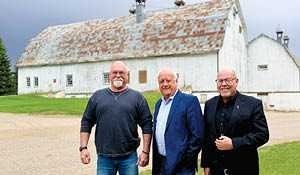
Opportunities for local ag and food tech entrepreneurs were bolstered recently with the signing of a Memorandum of Understanding between Cultivator powered by Conexus and the Saskatchewan Food Industry Development Centre (the Food Centre). The two entities put ink to paper on July 8 at the Food Centre in Saskatoon.
“This is a brand new partnership, so Mehmet (Caglar Tulbek, president of the Food Centre) and myself connected a couple of months ago, right before our kickoff week in April,” explained Laura Mock, Cultivator powered by Conexus Director. “Just being in the agriculture space in Saskatchewan, I knew about Mehmet, and I knew about the Food Centre just at high level. Everyone that I talked to says nothing but wonderful things about the work that they’re doing.”
The Food Centre is well known for its contract research, manufacturing, and incubation services. Cultivator’s AgTech Accelerator supports founders in their journey to develop and commercialize their agricultural innovations.
“After meeting with Laura and the Cultivator team, we saw overall what the Cultivator program offers, all the incubation space, and supporting the companies,” said Tulbek. “What we need in Canada now is really more and more entrepreneurs; more and more agri-food transformation and creating the value at the farm, or value added, or up-cycling, or any type of new manufacturing.”
The Food Centre has been around since 1997 with quite a bit of experience in food manufacturing and processing. Their focus over that past few years has been on their feed program, female entrepreneurs, and agri-food development; among other programs.
“We have quite a bit of engagement, support, and the knowledge base supporting the entrepreneurs and founders in this space, and now with Cultivator - especially with AgTech - up-cycling, and on farm to fork, or any type of innovation coming from this whole agri-food ecosystem,” Dr. Tulbek said. “it’s a really great opportunity for us to work with all the founders that Cultivator is working on, so that’s why it’s very important, and we are quite excited about the partnership.”
Benefits for entrepreneurs
Where the new partnership really shines is what it offers for entrepreneurs across the province. The collaboration opens up new connection opportunities for both sides, and ultimately expands that web for the companies they both support.
“In Canada and Saskatchewan, there are a lot of resources and there are a lot of programs available, but it’s highly complex for entrepreneurs and founders to navigate to know what’s the value, how will it actually propel a business forward, how do you get in,” Mock said. “For us, I think the biggest value at the forefront is by collaborating and taking an ‘entrepreneur first’ perspective to help them navigate and access some of the various resources.”
With that perspective of the entrepreneurs at the forefront, an easier path to success will result.
“We’re making their lives easier, it should accelerate our ability to support them,” Mock said. “For them to have a product that they’re developing or an innovation through to commercialization, the more we can create cohesion with those supports it should help companies to get to the finish line or to build a company where they’re profitable faster. It should minimize the overall resources that we’re having to put into these companies, and hopefully, too, it just makes the founder journey a lot easier. It’s a difficult journey, but if we can support them and help to guide them so that it’s less stressful, I think that is a massive win.”
Tulbek agreed that maintaining those networks is a crucial ingredient for business to thrive.
“It’s all about all ecosystem development and cohesive connections and communication within all the organizations, especially Cultivator support to all these founders,” he told the World-Spectator. “They have so many programs, so many activities, but we are like a technical organization with several technical supports complementing their business supports; the networking. It’s basically supporting and empowering each other so that these founders can move further in their business pathways. That’s really the critical piece, because when you think about the provincial support, federal support, there are so many organizations. But again, working together and opening the channels and keeping the channels open, and then continue helping the company - that’s really key with this relationship.”
A prime example of the concept of stronger networking could be seen in who attended the MOU signing last week including provincial and federal representation between Innovation staff and Prairie Economic Development Canada, Ag-West Bio, GIFS (the Global Institute for Food Security) and Opus, which is a pre-accelerator program out of the University of Saskatchewan.
“Part of the Saskatchewan advantage is the connectivity, cooperation, and collaboration in our ecosystem,” Mock said. “If you go to other provinces or other regions - probably other countries - organizations are acting very independently with a focus on their individualized program. In Saskatchewan, there’s so much connectivity between the farms, the distributors and then the ecosystem of support coming together where instead of focusing on our own objectives, we are really committed to bigger objectives that will drive the economy, agriculture, and the outcomes that we’re looking for.”
Saskatchewan ag and the global market
An area that especially sets Saskatchewan apart from a global perspective is the variety of products on offer.
“Overall, Saskatchewan is really the specialty capital of North America,” said Tulbek. “When you think about the overall cereals, pulses, and oil seeds we grow, what we have is diversity compared to what’s happening in the production space in the United States, because that’s mainly turning into big corn and soybean production.”
In addition to traditional cereals and pulse crops, Tulbek also pointed to the fruit and vegetable varieties, and not to mention the whole realm of livestock markets found here.
“The sustainability, the low carbon footprint, and some of the studies Global Institute of Food Security has been presenting and publishing; it really shows that overall not only the specialty, but also the sustainability strength of the province here in Saskatchewan,” he said.
This week is also when the popular Ag in Motion farming expo happens in Langham, with the AgTech Accelerator holding their demo day on July 16.
“We’re really seeing an amplified cross section of the agriculture industry; innovation,” Mock said. “We have investors coming from across North America. We have different government representations, both provincial, federal, and global as well. We have lots of different countries that will be represented there, so a great opportunity to highlight the future agriculture innovation to such a curious and hungry audience.”
There are 15 companies in Cohort 4 of the AgTech Accelerator, 10 Canadian-based and five from the United Kingdom. Ag in Motion marks finale week for Cohort 4 in the Accelerator program; the culmination of a three-month deep dive for companies accessing capital, programming, connections, and mentorship to help them grow. Through the previous three cohorts, the AgTech Accelerator program has supported 47 companies in raising $119.2 million in private capital, $72.1 million generated in revenue, $44.4 million in public funding, and 193 new jobs created.











-SM.jpg)








 sm.jpg)