Eagle Ridge Sled Dog Kennel preparing for upcoming race season
September 2, 2025, 9:58 am
Kara Kinna
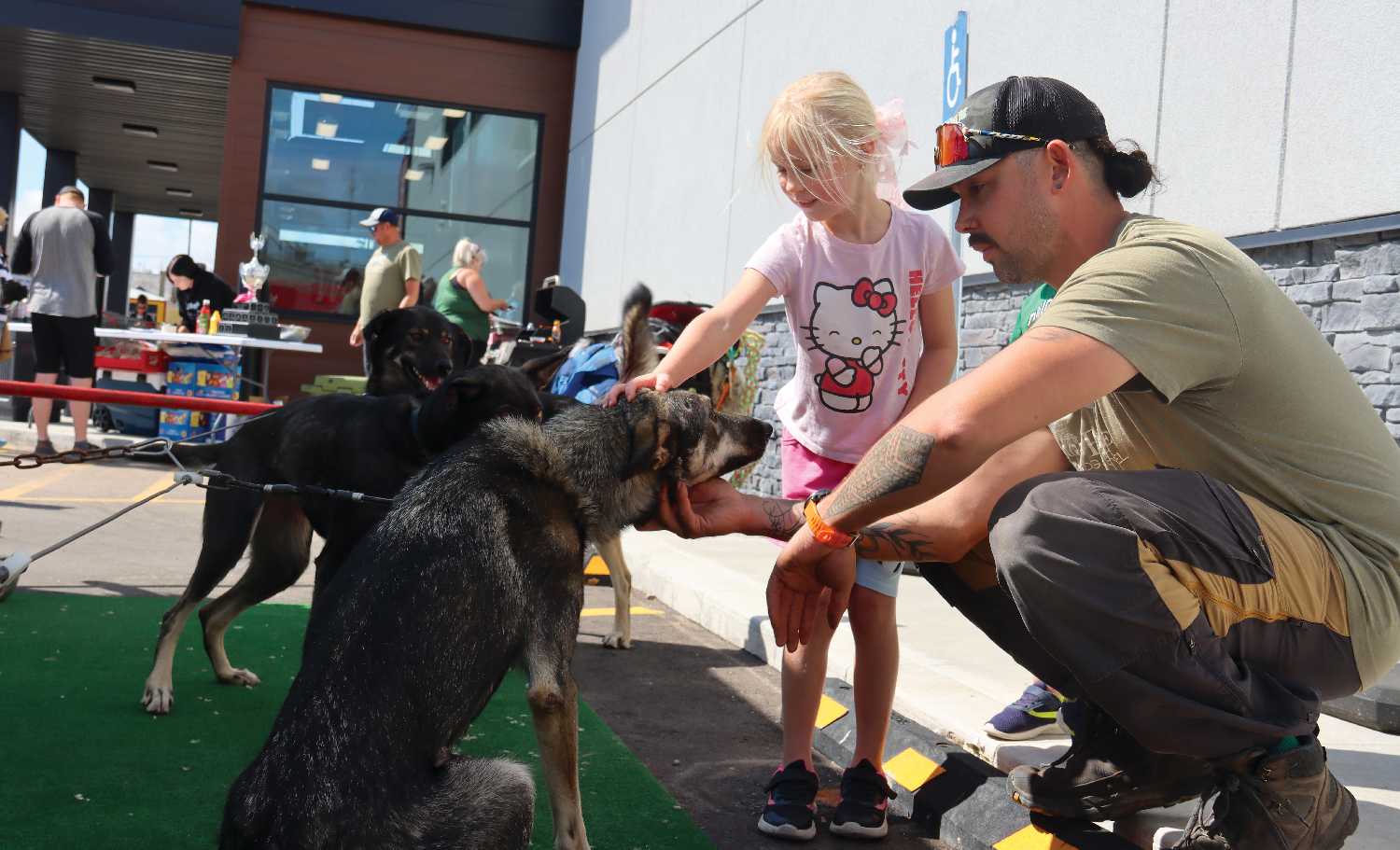

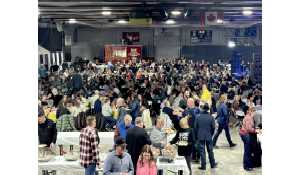
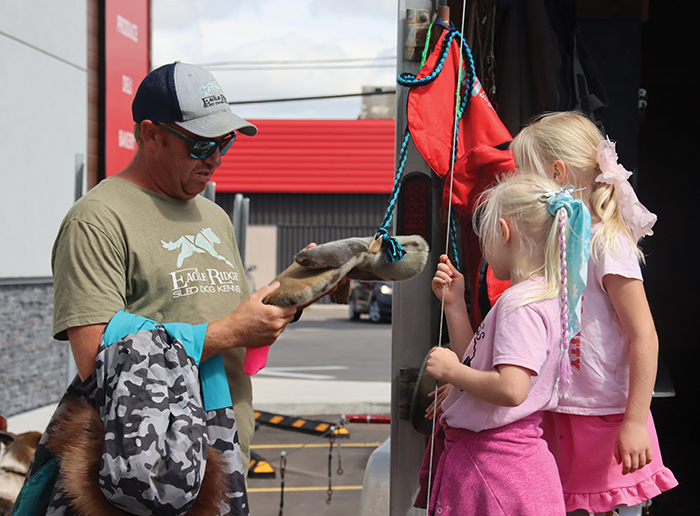
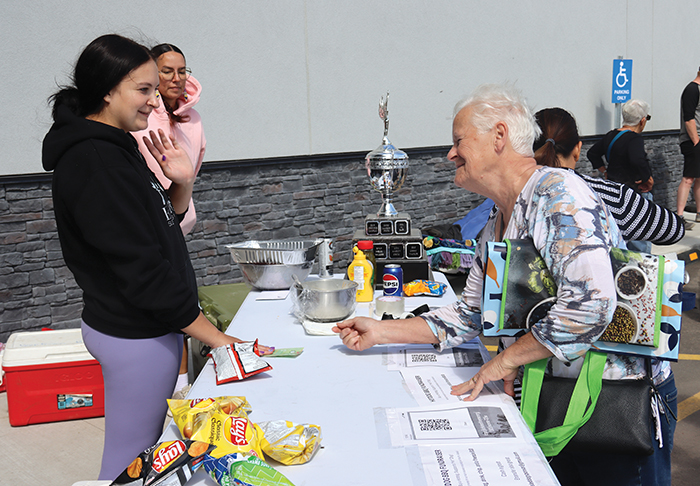
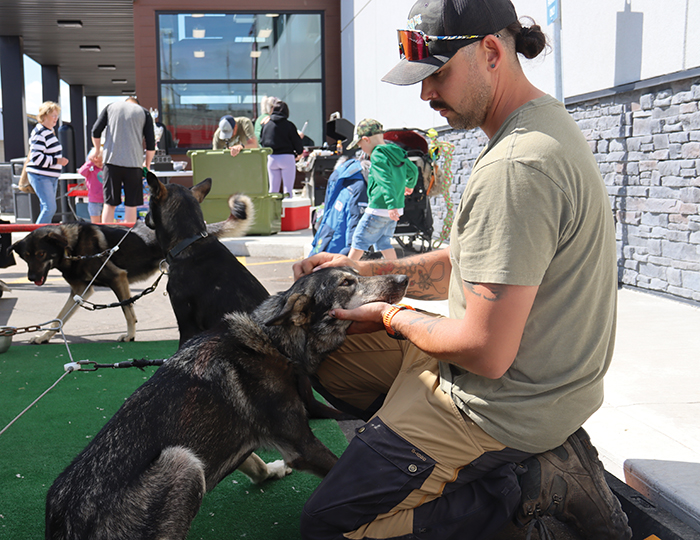
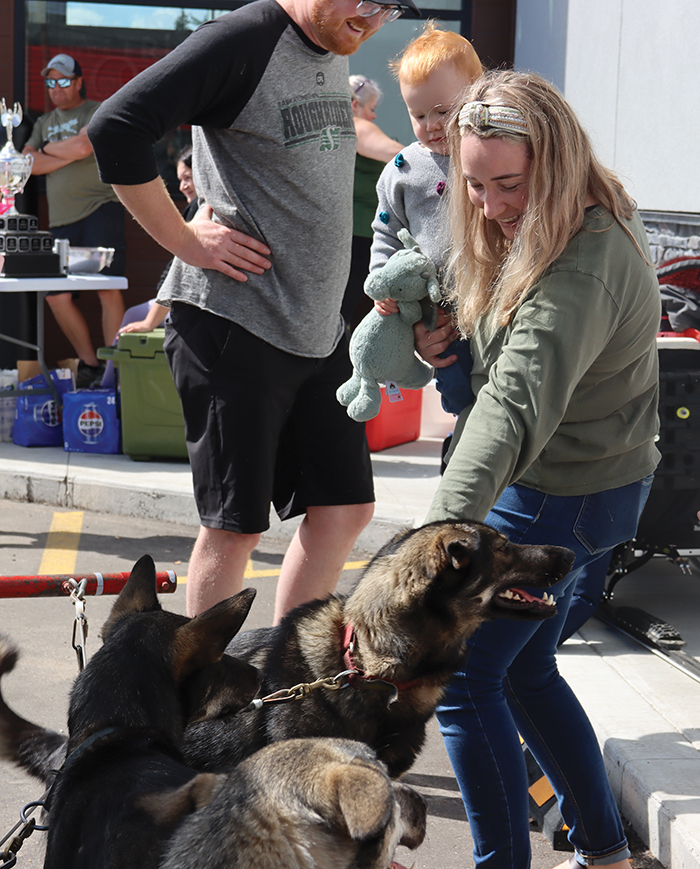
Eagle Ridge Sled Dog Kennels was at the Borderland Co-op Food Store in Moosomin on August 23 hosting a fundraising barbecue that day and giving people a chance to meet some of their dogs and mushers, and learn about dog sledding.
The kennel is located just north of Wawota, and just like any athletes who compete at a high level, the kennel was raising money for their upcoming race season, and the dogs and mushers have already been conditioning for the season, especially for the Iditarod, a 1,000-mile race held in Alaska every year.
Garrick Schmidt, the owner of Eagle Ridge Sled Dog Kennels, says he grew up with dogs, but not with dog sledding, which came later for him.
“I grew up in Indian Head and then I taught at Ochapowace and White Bear for many years. I taught at Ochapowace for two-and-a-half years, and White Bear for one and then up north, so I’ve kind of been all over,” says Schmidt.
“We always had dogs growing up. Growing up in Indian Head, my mom’s friend was a teacher but she lived up in Christopher Lake but she grew up in Indian Head.
She would bring her dog team down during Christmas holidays when I was a kid and my mom would take me over there and we would hang out and spend time with her and her dogs. We had a stubborn Siberian husky at the time and I had to put her in her harness and get her to run along. It worked okay but she didn’t like running that much.
“Then around 2020, when I was teaching in Ochapowace my first year, I ran a land based education program there. I taught primarily Grade 8 the first year and we were out on the land almost every day or every other day, and in the winter time we had a little trap line behind the school and surrounding the school, so we were skinning rabbits and checking and harvesting medicine and doing things like that.
“There was a week-long winter festival during winter solstice, and Kevin Lewis came down with two truck loads of dogs and his crew of handlers and mushers and they did dog races there for the school. For that I brought my Grade 8 class out and they got to work with the dogs. Some of the kids really thrived out on the land and they got to hang out all week and drive a team of sleds and a team of dogs and they got to give their friends a ride in the sleds and they did really well. They had a lot of fun doing it.
“The week after, Kevin and those guys were going up to Cote and had asked if I wanted to go up for a couple of days to help and hang out, and that is kind of where our bond and relationship grew. And I call him an older brother now. He runs a land based camp and he gifted me my first real sled dog about five years ago and I bought my first team of dogs from him at almost the same time.
“I started with eight dogs and I have 33 now.
“Everyone always thinks we have Siberian huskies, big fluffy beautiful dogs, no they are Alaskan huskies. They are essentially a purpose-bred mixed breed, so within their blood lines, the goal is long distance racing with them, like marathon running with the dogs anywhere from 100 to 1,000 miles.”
While dog sledding isn’t something Schmidt does full time, it’s a big part of his life and his culture.
“My fiance Megan and I work for Métis Nation Saskatchewan. We’ve helped design and create a mental wellness and trauma land based program in the province for locals in Saskatchewan. We provide funding to locals and they are able to use the funding for land based programming to get elders and community families out to events. We are Eastern Region III and we are a big part of the Métis Nation of Saskatchewan and we do a lot of programs for the region, a lot of camps. We help facilitate the bison hunting camp but we also do a winter camp usually before Christmas.
So we have the dogs there and we do some trapping demonstrations, skinning, and then we usually have some rabbits in the freezer that we take or even just having the fresh rabbits there so that we can show people how to do it.”
Schmidt says that dog sledding was more about teaching and recreation before it became competitive for him.
“It started as a teaching and recreational thing because when I got into dogs, my goal was when I was teaching in the communities to inspire the youth, to maybe pick this up in each community that we were a part of and that we were teaching at.
“(Junior racer) Monroe (Mondor) and her family have been a part of the kennel for about five years, and so now it’s kind of gone from that recreational teaching mind-set to us trying to be competitors.
“This last year I ended up winning the Canadian Challenge up in La Ronge. That was a 200-mile race and I did that as a qualifier. I didn’t have any intention of being competitive and maybe finishing middle of the pack. So the skill set that I’ve had has grown over the years for myself and I’m sure the same with the dogs.
“The new bloodlines with the dogs over the last three years—there are more distant bloodlines, there are more championship bloodlines in the kennel, so the four dogs that are here (at Borderland Co-op today), their parents have done the Yukon Quest, and so that’s kind of what the goal is for the kennel one day.
“My goal for the next couple of years is to do Iditarod, the big 1,000-mile race in Alaska. This winter Monroe, this is her last eligible year as a junior musher, so she is going to register and go and race the Junior Iditarod in Alaska. It’s a 150-mile continuous race, so she will race against some of the best dogs in the world, and some of the best junior mushers in the world. She is right up there.”
Why is dog sledding important to Schmidt?
“It’s the connection that we have with the dogs and the community behind it,” he says. “It’s easy to put gas and oil in a snowmobile, jump on it and go for a 100-mile cruise, but it’s a lot different with the spiritual aspect too of hooking up say 10 to 15 dogs and racing 200 to 300 miles. So you’re on the trail for two to three days straight, sleeping in the straw beside the dogs, it’s a huge bonding thing that’s built from day one until your very last race, so there is always growth behind it.
Schmidt says there is a cultural connection to dogsledding as well.
“If you look back at the fur trade during 1700s and 1800s all across northern Canada. Even the southern part of the province before there were horses, the Indigenous community would use dogs to travel everywhere. Whether it was hauling gear in the summertime or having a team of dogs hooked up to a sled, kind of like the old wooden toboggans we would use as kids.
“I think the big thing about the cultural aspect is continuing and passing it on to young people, old people, honestly anyone that wants and is willing to learn because it’s a lot of work and a huge time commitment. It’s a big love because the dogs, they give you everything that they absolutely have. I try to give them everything back in return but the connection that I have with the dogs is everything you need.”
Schmidt says there is still a lot the people in the general public don’t know about dogsledding.
“There is still a lot that I could learn, but I think that for general public, people think that when we roll up to an event, people always say “are those the huskies?” “Oh wow they are so small.” You have to realize that yes there are people that run the Siberians or the Malamutes but there all purpose driven. With the Alaskans, they’ll do comfortably 10 miles an hour, and we can do 50 to 60 miles in five to six hours.
“It’s really nice to think that I can’t remember the last time that anyone had anything negative to say. They see how well behaved the dogs are and how happy they are. It’s always a teaching moment and it gives us teaching opportunities. Having that teaching background myself helps bigtime. It kind of helps showcase the breed but also the sport and the cultural diversity behind everything.”
Schmidt said the barbecue being held at Co-op that day was to help with upcoming seasonal costs.
“It will help with kennel expenses for the racing. There are entry fees for races, gear that we need. Usually every year we go through anywhere between 2,000 to 2,500 booties for the dogs—the little shoes for the dogs. We don’t order those from the pet store. They are specially made.
“Going into Alaska this year, all the dogs are microchipped and they have to have their vaccination for each race for kennel cough and other things. And then it just kind of helps to get us down the road down the trail.
“Also we go through a lot of raw meat throughout the year. We will order like 80 blocks of ground chicken, so those are like 50 pound blocks from Baldwin’s. We get ground beef and other meats to feed the dogs.”
Schmidt says there are not a lot of dog sledding operations in the area.
“It’s kind of rare around here, we are the only ones. There are more up north. I think the closest one might be north of Virden.”
Schmidt says even though it’s warm outside, training has begun in earnest for the upcoming season.
“With the cooler temperatures at night, we start training usually in September, but the last couple of days have been perfect weather, it’s been plus four in the mornings when I get out at 4:30 am. The dogs training consists of being hooked up and harnessed on the gangline. We just put them in front of the quad and put the quad in second gear, and that way it is more resistance training. Right now we are juts building muscle and conditioning back.”
Schmidt says dog sledding is a serious sport, and it’s inspiring to see young mushers like Munroe take it on.
“Last year at the end of the year when the snow was all gone, I think my team had like 2,500 miles on them.” he says. “Up in Whitehorse and I go visit a buddy that is a Métis musher as well. He had like 5,000 miles on his team.
Then Jessie Holmes had like 6,000 miles on his team. It’s a huge time commitment and it’s really cool to be able to see Monroe’s growth with the sport over the last four years, where she can confidently hook up 16 dogs, and I know she’s going to be able to handle situations. She comes back and she’s happy and she’s healthy and she’s taken care of and she’s also taking care of the dogs. I am excited to see her progression over the years.”
Tweet