Enbridge proposing Line 26 optimization project to transport oil from Cromer to the U.S.
Pipeline project would export 250,000 barrels per day
April 13, 2026, 9:07 am
Kara Kinna
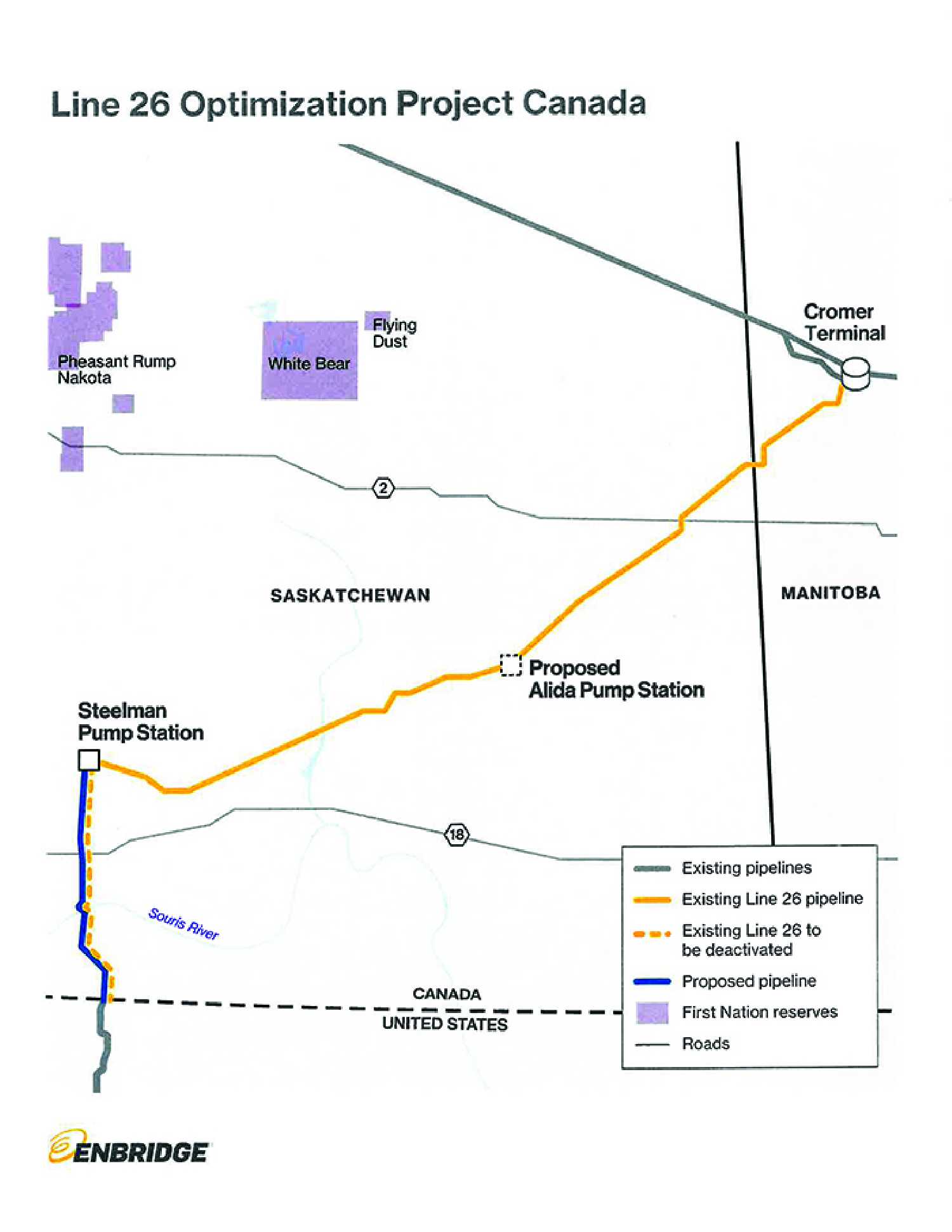

Enbridge Pipelines is planning to submit a proposal later this year that would see its existing Line 26 from Cromer, Manitoba to the U.S. border reverse its south-to-north flow and transport 250,000 barrels per day of Canadian light crude oil to the U.S.
Currently Line 26 carries roughly 145,000 barrels per day of light crude oil from facilities in the U.S. to the Cromer, Manitoba facility.
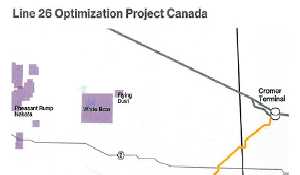
The proposal suggests deactivating an existing 12-inch pipeline from the Steelman pump station to the U.S. border, and constructing a new 24-inch pipeline segment to replace the existing 12-inch pipeline so that oil can be transported southwest from Cromer to Steelman, then south from Steelman to the U.S.
A new pump station would also be constructed at Alida, between Steelman and Cromer, as part of the proposal. A new pump station would also be located within the existing Cromer terminal, and there would be equipment modifications to the existing Steelman pump station.
Enbridge says the project could assist in lowering and stabilizing energy prices and improving energy security.
“The Line 26 optimization project is part of Enbridge’s broader Mainline Optimization Phase 2 project, which if approved, would add 250,000 barrels per day to Enbridge’s liquids pipeline system. This follows Mainline Optimization Phase 1, which Enbridge is currently working on implementing and will add 150,00 barrels per day by approximately the end of 2027,” Enbridge told the World-Spectator.
“Combined, these two projects will advance approximately 400,000 barrels per day of oil transportation capacity to refining markets in North America.
“In Canada, this could enable production growth from Western Canada and provide shippers with options to ship their products to U.S. refiners and global markets, where they can get the best price for their commodity, resulting in economic growth and prosperity for Canadians as well as additional revenue through taxation and royalty payments that can be used to pay for healthcare, education and critical infrastructure.
“Both the market and governments on both sides of the border have indicated that more needs to be done to grow the economy and meet increasing energy demand. This project could help achieve both of those objectives.
“Independent market forecasts see 500,000 to 600,000 barrels per day of supply growth in Western Canada by the end of the decade. Additionally, the Enbridge Mainline is regularly apportioned (e.g. in 2025 it was apportioned nine out of 12 months). That forecasted growth, plus lack of transportation availability, is a strong indicator this project is needed.
“Enbridge does not offer priority service contracts on the Mainline system and the Line 26 optimization project will be considered part of the Mainline service; however, Enbridge will be expanding the Flanagan South pipeline system in conjunction with the Mainline Optimization Phase 2 and will be offering contracts for service on that pipeline system.
“Production from Southeast Saskatchewan and Southwest Manitoba is able to access the Mainline system today at Cromer and will be able to access this capacity. Mainline Optimization Phase 2 will add an incremental 250,000 barrels per day of capacity which will move on the Line 26 optimization project. This will benefit all Western Canadian producers who access the Mainline system.”
Enbridge says, because this is not a greenfield project, and uses existing pipeline infrastructure, they don’t anticipate as many hurdles to getting the project approved.
“Many of the permitting risks and requirements that would apply to a greenfield project don’t apply here as this project involves optimizing Enbridge’s existing pipeline network and using joint ventures with other companies,” says Enbridge.
“By optimizing existing pipeline systems and leveraging our established right-of-way, we can deliver meaningful, cost-effective capacity additions with lower community and environmental impacts and lesser permitting risks compared to new greenfield developments.”
What other projects does Enbridge have on the go to increase Canadian oil flowing south?
“We sanctioned the first phase of our Mainline expansion (MLO1) in Q4 last year, which will add 150,00 barrels per day and is expected to be in-service by the end of 2027,” says Enbridge.
“We’re now commercializing Mainline Optimization Phase 2 (which includes Line 26), which could add another 250,000 barrels per day of transportation capacity to the Mainline as early as the end of 2028.
“We continue to engage with our customers on how we may support their production growth beyond the first two phases of Mainline Optimizations.”
Enbridge says they expect a final investment decision on the Line 26 optimization project by mid-2026.
Work on proposal full speed ahead
Jesse Semko, a spokesperson with Enbridge, says work on the Line 26 Optimization proposal is full-speed ahead with the hopes of seeing the project approved.
“What we’re doing right now is talking to our shippers to make sure they like the idea and they agree with it,” he says. “We’re having those conversations. At the same time, we started engagement with Indigenous groups, communities and landowners to inform them of what we are thinking and to see if they have any concerns or comments.
“We take all that feedback and we aggregate it, and we refine the scope even more, and then based on that, we decide if we go ahead or don’t go ahead. We’re planning to make that decision around the middle of this year.”
“There are a whole bunch of factors at play. We’re an energy transportation company, and so we talk to shippers all the time, and they tell us if their needs are being met or if they want more capacity. And they have certainly expressed an interest in having more capacity, more opportunity to transport energy.
“Line 26 comes out of the main line at Cromer. The main line system is a network of several pipelines, and there are no contracts on it. Basically every month, shippers come to us and say ‘next month we’d like to transport X amount of heavy crude or light oil.’ And when those requests exceed its capacity to transport, it’s called being apportioned, and the system is regularly apportioned. It basically means it regularly doesn’t have space to transport more capacity. The demands to transport exceed its availability. That shows to us that the market is interested and wants more transportation capacity.
A shift in public opinion
“The other thing is that there has been a shift in public opinion with governments on both sides of the border recently, and they have realized the benefits of both economic prosperity and energy security,” adds Semko. “So by transporting more Canadian energy to the U.S.—and Canada has the highest regulatory and environmental standards when it comes to producing this energy—we can do a few things. First of all by transporting more, we generate more revenue locally. So there are more jobs involved, more royalty payments, more taxation. That’s all revenue that can then go to local governments to help pay for things that Canadians want—like help to pay for roads, hospitals, critical infrastructure, schools and stuff like that.
“At the same time, by producing more energy, you can also stabilize or drive down energy prices just because the demand stays the same, and you add more energy and it helps to keep prices low. So that’s the other element.
“Both governments, on both sides of the border have expressed an interest in developing more energy products to increase economic prosperity help to increase energy security and affordability.
“So you have all those things—the commercial side and the government side, and the public side, and those all kind of have converged and that has led us to look at our system and what work we can do to optimize it to allow for more energy to be transported.”
Talking to shippers
Semko says Enbridge is in the process of talking to shippers about using the pipeline’s capacity to ship to the U.S.
“That’s all in discussion right now. We are talking to shippers and asking if they are interested. We think that there is that demand, but we’re still working out those details,” he says.
He says there would be an opportunity for shippers from Southeast Saskatchewan and Southwest Manitoba to use some of that capacity.
“Yes, absolutely. The way it works, Cromer is kind of like a hub and crude light oil and NGLs (Natural Gas Liquids) flow from Edmonton and Hardisty down to Cromer. But there are also feeder lines that come into different stations,” he says. “There could be feeder lines throughout Manitoba and Saskatchewan that feed into Cromer as well, and they could use the Line 26 optimization to ship south and enable access to producers in Alberta, Manitoba and Saskatchewan.
“When it comes to the main line, any month, any shipper in any of those provinces can put up their hand and say, ‘Hey, next month, I need this much transportation capacity,’ and so they have access to the system.”
Project uses existing network
Semko says because this project would involve using Enbridge’s existing pipeline network and will mostly take place on Enbridge property, the company anticipates minimal hurdles.
“This project is a little different,” he says. “I know that there are a lot of things that need to be ironed out with the Canadian regulatory system and things that the federal government is talking about to increase energy development. A lot of those problems in theory shouldn’t be present with this project because it’s using existing infrastructure.
“When it comes to pipelines, you have a greenfield project, which is a brand new project, and you have a brownfield project, which is often using existing infrastructure and you’re just making tweaks or optimizations to it. So because this is an existing pipeline, and we’re just optimizing it by reversing the flow, deactivating one part of the pipe, replacing it with a larger pipe and adding pumping capacity to it, it shouldn’t encounter as many of the problems that could slow its development from happening like a big greenfield project.
“That’s one of the advantages of having infrastructure like this is you can work to optimize it and make it transport more energy.
“We’ve just started to discuss this with Indigenous groups, communities, and landowners. Those conversations, along with conversations from our customers, this early stage development work is really, really helpful. What that does is it gives us a whole bunch of feedback that we can use to make this project even better. And so if we do that, and do that work well, hoping that there shouldn’t be any problems, it should go relatively smoothly.”
Early stages
Semko says it’s too early to know how many people would be employed if the project moves ahead.
“We don’t know that yet, just because the way it works when it comes to project development is you start with the initial development stage, which we’re doing right now, and then it reaches a final investment decision, which happens mid year, and when we know we have a project and are going ahead, usually at that point we undertake something called a socioeconomic assessment. We do a big study saying based on all the work that we’ve agreed to do to make this project happen, how many workers would we need? How long would we need them for? Will they be needed? How much is that estimated to contribute to the local economy? What are all the ancillary benefits to the communities from hotels to the food services? What would be the result of increased taxation flowing to all the communities?
“Once we know if we’re doing this or not, mid year, and we commission that study, we’d have all that information. But right now we just don’t know. It’s a little too early in the development process to know that.”
In the public interest
“We believe this project is in the public interest, and it could assist in lowering and stabilizing energy prices, and improving energy security,” concludes Semko.
“It’s still early in the stages of development, but we’re interested in hearing from Indigenous groups, communities and landowners, and through those conversations and feedback, we’re hoping we can come up with a really good project.”