Cockrill says plan will have impact on health care in rural Saskatchewan
Patients First Health Care Plan
March 16, 2026, 2:21 pm
Nicole Taylor, Local Journalism Initiative Reporter
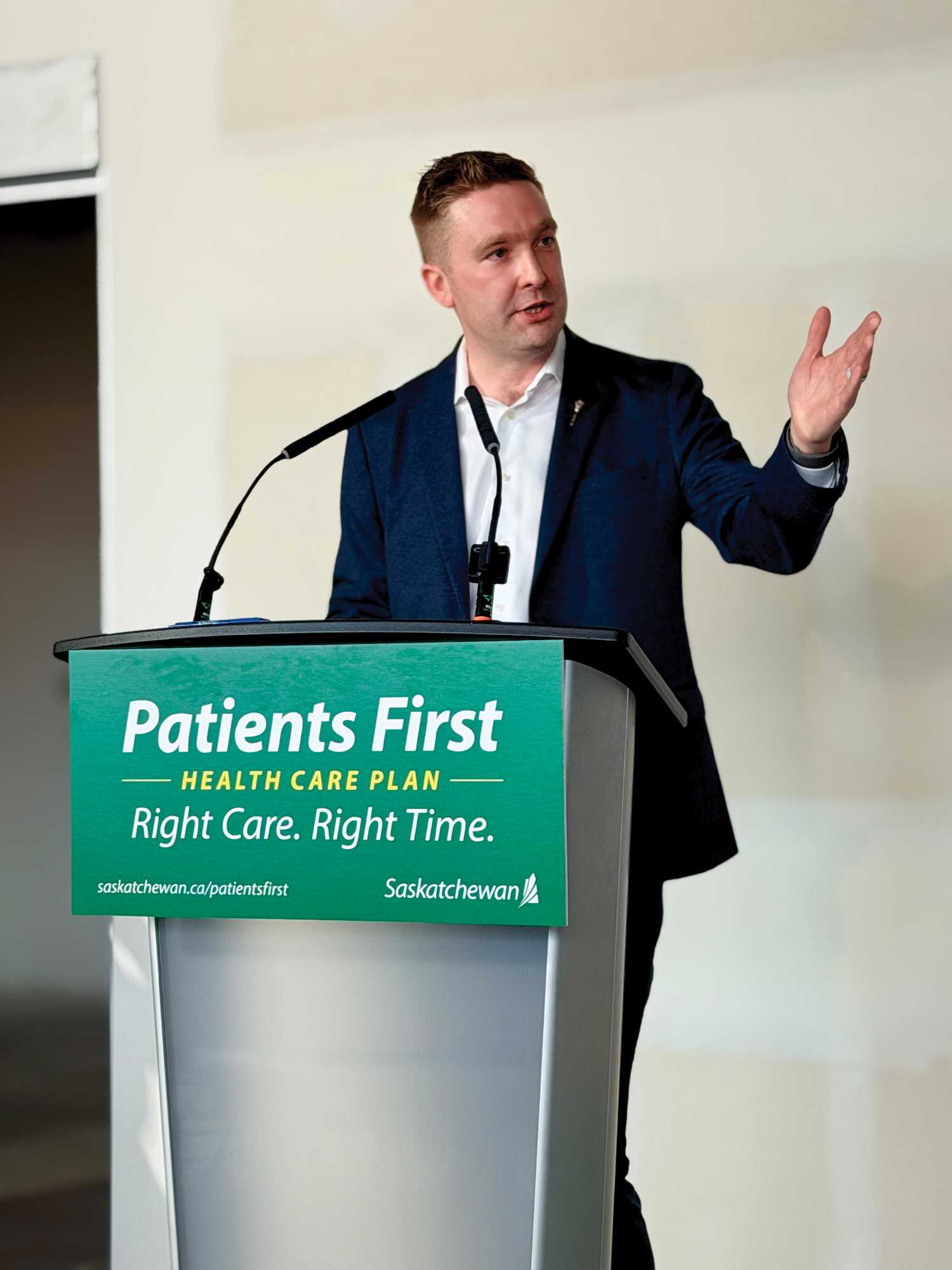

On Monday, the provincial government announced the Patients First Health Care Plan—a sweeping plan that includes expanding access to virtual care, continuing to recruit, train and increase the number of doctors, nurses and nurse practitioners, expansion of diagnostic services like MRI, CT and PET-CT scans, increasing the number and expanding the scope of practice for all health care professionals, and reducing the community portion of capital costs for new facilities from 20 per cent to 10 per cent.
The World-Spectator interviewed Health Minister Jeremy Cockrill last week about what in the plan will have the most impact on health care in rural areas.
Following is the interview:
Why did the provincial government feel that this plan was necessary?
I’ve been in this role now since November 2024, and when we’re not sitting in our legislative session, I try and spend as much of my time out there visiting facilities and speaking with folks who work in the health care system, patients and their families.
And it comes from a conviction that I’ve felt, and I know the premier has felt, and I know Rural and Remote Health Minister Lori Carr has as well, and I would say our whole government caucus that the health care system—while there has been some positive steps forward in recent years after the pandemic—the conviction, I think, is really that the system needs to be very focused on patients. That needs to be the sole focus of the health care system.
It’s a large, complex system, there’s lots of moving parts, but at the end of the day, if decisions aren’t rooted in what’s best for patients, then what are we doing as a healthcare system?
I know there has been some criticism recently that we have talked about patients first before. Yeah, we have. And I think this opportunity, this plan, is really a renewal of that commitment, and I think a reminder to everybody in the sector about what matters most.
There’s quite a lot in the plan. What initiatives in this plan will have the biggest impact on health care in rural Saskatchewan?
I think the nurse practitioner piece. And I say piece singularly, but it’s really multiple initiatives to enhance the role and nurse practitioner capacity we have around the province.
I’ve seen it in other arenas. This is really an all-in approach on nurse practitioners. And I think nurse practitioners have been incredibly successful where they’ve been in the system already. We introduced the independent contract model last year. We have started awarding the first few contracts. But as I meet nurse practitioners around the province and meet people who see a nurse practitioner in a primary care context, people really enjoy the quality of care they get from nurse practitioners, and I think they can play a bigger role.
And so I think there’s a massive opportunity for them to really take on the leadership role in terms of being the most responsible provider in long-term care settings. I think there are excellent opportunities for nurse practitioners to take larger roles in emergency rooms and urgent care centres, which is already happening. I think they’re a nice complement to the physicians that we have in those facilities. And so we’re looking for more ways to train up nurse practitioners in acute care and make sure that they’re ready to deliver care in those contexts.
“But the biggest impact, I think, on rural Saskatchewan, is really around taking the cap off of independent nurse practitioner contracts and allowing those nurse practitioners to hire other professionals—so other members of the nursing team or dieticians or it could be social workers or other health care professionals—so they can build out full primary care teams in communities right across the province. This is already happening in several physician clinics around the province, but we think that nurse practitioners should be able to lead these teams as well.
“And I think one of the most significant pieces is that new financial incentive to encourage RNs to become nurse practitioners. Because when I am around the province talking to registered nurses, saying, ‘Hey, why don’t you become a nurse practitioner? What’s holding you back?’ The reality is that the training becomes an inconvenience and a cost to them personally.
They have to take time off work, and they have to take time off to do clinical placements. So if you’re a young parent and you’ve got kids, it’s hard to take two years off work to upgrade. That comes with financial sacrifice. And not everybody can do that.
“I think that’s really going to be the opportunity for rural communities, is finding an RN in their community that’s committed to their community and to their region, and encouraging that RN and saying, ‘hey, why don’t you look at becoming a nurse practitioner, there’s a $78,000 benefit for you over a two-year period. It does come with a return of service contract. But think about the expanded care that you could offer in our rural community and to our larger region. I think that opportunity is probably the biggest for rural Saskatchewan out of this whole document.”
So with these changes, could you actually see nurse practitioner-led clinics, like a doctor’s clinic, but just with nurse practitioners instead?
Yes, absolutely. That’s already happening. We already have 23 nurse practitioners in the province under these independent contracts, but we want to see more of that, and then we want to see them build out their teams. On the physician side, we’re already doing this through our patient medical homes and through the Innovation Fund that we have through our agreement with the Saskatchewan Medical Association, where doctors are able to hire other professionals, build out teams, and really, I think that’s a more efficient way to see more patients.
“But when you go to a clinic as a patient, you may not necessarily need to see a doctor or nurse practitioner. An LPN, for example, could help you out with, say potentially, discussions around a chronic disease or other issues that you may have, and I think that’s where there’s massive opportunity as we build out these teams.
So basically, under this model, you’re not funneling everybody to a physician all the time, you can spread them out to different health care providers?
Yes, and it’s important to note there’s also enhancements for physician training as part of this document as well—a nearly 20 per cent increase in our College of Medicine undergraduate seats, from 108 to 128. And I think sometimes in healthcare, we get so locked into these discussions, either or discussions about nurse practitioners or physicians. Well why don’t we expand both? Why don’t we create options for both to be available in communities right across the province? There is sometimes some competition between different professions, but as a patient, you really don’t care about that. You just want to make sure that there’s a practitioner available to you when you need it.
One thing that is a particular challenge for rural health care delivery is staffing. What in this plan will help with staffing challenges in rural in rural Saskatchewan?
We made significant enhancements to training seats across the province, and this plan talks about that in terms of some of the work that’s been done in terms of adding training seats, and I think the real priority here is—whether it’s physicians, nurse practitioners, registered nurses, LPNs, all the whole spectrum of health care workers—we’re trying to make sure that training is as distributed as possible right across the province.
The challenge is that when you start new training seats, you don’t necessarily see the benefits of that for a couple of years. And so we’re going to start seeing the benefits of that distributed education over the next couple years. So that’s coming down the pipe for us.
But in terms of what’s new in this plan, we’ve expanded the rural physician incentive program to regional centres, whereas right now it has just been available in smaller rural communities. So the Yorktons, Moose Jaws, North Battlefords, Swift Currents—now physicians going there will be eligible for that significant incentive, which is $200,000 over five years.
And we’ll be continuing to expand the list of eligible communities under the Rural and Remote recruitment incentive. That’s been an incredibly successful incentive in terms of filling full-time positions and reducing our reliance on travel nursing and overtime as well. We’ve already hired over 500 healthcare professionals through that incentive, and by adding more communities and looking at adding more professions to that incentive, that will help fill some of the gaps that we have in rural Saskatchewan and make sure that people are taking full-time positions.
Tell me a little bit about the virtual access to health care in this plan. How do you see some of those changes having an impact on rural Saskatchewan?
The virtual care announcements as part of this plan are probably the second most impactful for rural Saskatchewan, but it could be argued that they’re as impactful as the expansion of the role of nurse practitioners. Let’s face it, all of us just do more virtually on our phones. We pay bills on our phone, we submit meter reads to SaskPower on our phone so we don’t need to have someone coming through our back yard and checking our meter. And it’s not just young people. I hear it from older patients as well who want that access and are willing to receive health care virtually, when appropriate.
So I think there’s huge opportunity here in terms of making that more episodic primary care available to patients on demand. That’s what our commitment is, that we’re going to be rolling that out to unattached patients across the province. So if you don’t have a nurse practitioner or a relationship with a family doctor in your community, we’re going to give you access to a virtual care platform where, if you need a prescription renewed, or you need to ask a question of a health care provider, you’re going to have access to that on your phone, in the comfort of your home, or sitting in the car and parked on the side of the highway, wherever you may be.
That’s really part of the big theme of this whole plan is people receiving the right care at the right time in the right place, and more and more, that health care doesn’t necessarily need to be at a health care facility. We want to go to where patients are, and the virtual care is a big part of that.
There’s a lot of work to be done if all of this is carried out. What’s the timeline on some of these initiatives. Are some of these happening right now, and will others take longer to implement?
There’s really a variation across the whole plan. The plan talks about some things that are already in process, like the nurse practitioner contracts, for example, that’s already in process. And this plan just adds a few more dynamics and accelerates the pace of change there.
The virtual care will take some time to roll out. We’re going to roll it out in a phased approach, and some communities will start seeing that hopefully by this fall, and hopefully even in the summer. We’re just working through our process on that, in terms of making sure that whatever that virtual care platform is, that it talks to our existing systems, like My Sask Health Record, for example.
For the training seats, at the College of Medicine, and the new nurse practitioner training seats, those will come online this September. Some of that immediate nurse practitioner stuff is happening now, but then some of those other things are going to start rolling out in the summer, fall, and towards the end of this calendar year.
Are there any challenges that you foresee in carrying out some of the things in this plan?
There’s no shortage of challenges in health care. Staffing, at the end of the day, is always a challenge. We want to have a patient focused system, but at the end of the day we need the health care human resources to provide that care, that quality care to patients. For recruitment, it is a competitive environment across Canada, because every province is dealing with the same challenge in that space. And so that will continue to be a challenge.
The other challenge—I think sometimes there’s a little bit too much turf protection in spaces like health care. I guess my ask or my encouragement to health care professionals around the province is that we need to look at doing things differently and being more flexible with allowing our whole health care team to figure out who is the right person to deliver the right care at the right time for patients.
There’s lots of interest in virtual care. There’s lots of interest in nurse practitioners. But I think as patients, too, we should not be afraid of change, and change is hard, but I think there’s going to be some as we roll out more options for patients, whether it’s for primary care or surgery, surgical options or diagnostics. I guess I would just encourage patients to be open to those new options and use them. That’s why we’re making these investments, and that’s why we’re putting them in place in communities right across the province, so that people can live healthier lives and have better outcomes.
The government has talked about how they’ve been listening to patients and health care providers when coming up with this plan. What are some of the things that you’ve heard from both patients and health care providers in rural Saskatchewan that have informed this plan?
I was at SARM yesterday, at the dialog sessions, and I introduced some parts of the plan to folks who maybe hadn’t read it all yet. And I think the nurse practitioner expanded role is really an answer to what we’ve been hearing from rural Saskatchewan for the last couple of years at least. Rural folks in rural Saskatchewan recognize the important role that nurse practitioners play, and that’s really what I think has driven us down the road here in this plan of making sure that we can expand that as much as possible.
And the virtual care piece as well. I think there’s also an answer to what rural Saskatchewan is looking for and asking for.
And I would just say, too, there are things that are not necessarily talked about in this plan, but things that have been already underway. Everywhere I go in rural Saskatchewan, obviously, everybody wants as good as services as possible, but they also want those services to be delivered efficiently, and they want to know that resources are being focused on the front line of care and not in administrative circles. We’ve made some changes working with the Saskatchewan Health Authority in the last year in terms of cutting administrative positions, refocusing those positions back on the front line, back in facilities right across the province, not focused in a head office.
What I heard yesterday at SARM, what I hear every week from rural Saskatchewan, is they want us to continue that work and continue looking for ways to be more efficient on the administration of the health care system, so that we can put resources right back in the front line and be hiring doctors and nurses and other health care professionals, the folks that actually see the eyeballs of patients every day.
Is there going to be a significant price tag attached to this plan? Or do we need to wait until budget time to find out a little bit more about that?
With budget day next week, more of the costing information will be available. The Premier said it publicly several times now, there’s likely not going to be a balanced budget across any province, across the country in any province or territory this year, and so that means that provincial governments have to make challenging decisions about how to use resources well, and how to invest in the services that folks want without creating too much of an affordability burden.
What you’re going to see next week in the budget is a significant, continued investment in health care. Because what we’ve heard from Saskatchewan people is that they want to see that investment. They want to see those services protected. They don’t want to see those services reduced. And so some of these items here are a significant investment. More training seats—that is a significant investment. More specialists, more positions being filled will cost more money, but I do think as long as we can make sure that money is well spent, that’s exactly the kind of thing that we need to be investing in, in this province.
The plan does mention the Esterhazy Hospital, and it does mention expanding CT scanner capacity. Could there be an announcement in the budget for both the Esterhazy Hospital and additional CT capacity in the southeast?
I won’t hint at announcements, but I would say discussions with both communities are still ongoing, and I would say there’s still some work to do in both Esterhazy and Moosomin on both of those projects before we can get to any sort of announcement.
With Esterhazy, we recognize that a significant capital investment needs to be made there. We having ongoing discussions with the community and the affiliate partner that runs one of the facilities in Esterhazy about what’s going to be the best long-term for Estherhazy and region.
“When it comes to Moosomin and the potential of CT services down the road in Moosomin, we still have some ongoing work with the Saskatchewan Health Authority to figure out the viability of that. But I think this plan is pretty clear that we want to make sure that people have access to services as close to home as possible. We need to be smart about how we use dollars, because these are Saskatchewan taxpayer dollars. But I think this plan leads us to ensuring that services can be available as close to home for people.
The other thing that was mentioned is the reduction of the community share, and that’s especially relevant for the Grenfell project that’s underway right now, as well as the Weyburn project that’s getting close to finishing—really reducing the burden on municipalities to participate in capital projects.
With Esterhazy down the road with that project, that means our local municipalities can focus on other infrastructure priorities and pressures that they have.
What else do you think is important for people to know about this plan?
It’s a very comprehensive document. I’m very excited about this work. The premier used the words ‘starting a conversation’ this week, and I think that’s really the case. I think what Saskatchewan people are going to see is that this document will continue to evolve over time. We’re not done listening to patients. That’s not stopping just because we put a plan out.
So as we receive more feedback from patients, as we get some of these investments across the finish line for communities, there’s going to be more work in terms of figuring out what’s next for Patients First.