Farm succession workshop draws large number
April 30, 2025, 10:02 am
Ryan Kiedrowski, Local Journalism Initiative Reporter

It’s a topic many people would rather not broach, but an extremely important one. Although farm succession is not an easy item for people to talk about, events like the Bridging the Gap workshop held in Regina certainly help open that conversation.
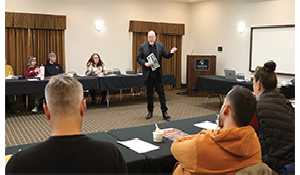
Around 130 agriculture producers attended the day-long information session on March 17, a number facilitator Trevor McLean—who is a National Lead with TransitionSmart, MNP—is pleased with.
“It’s great to have attendance, but it’s better when you have engaged attendance, which is using my gauge of how successful and needed the service is,” he said. “They’re asking questions, they’re scribbling, they’re following along in the workbook, they’re taking pictures of your slides so they want to be able to take the information back and share it with the people that they need to share it with.”
The statistics are not flattering with only 12 per cent of Canadian farmers in possession of a transition plan. Of those 12 per cent, a further 13 per cent are actively working on that plan.
“That’s a scary thought because, again, if transition plans reside in somebody’s head, what happens if something happens to that person? Now where do you turn?,” McLean asked, adding that without a plan, the entire farming operation that took decades to build is placed in a dangerous situation.
In the next decade, 75 per cent of current farms will trade hands, something McLean told his Regina audience. “Agriculture is the largest wealth transfer opportunity in Canada over the next decade,” he said.
Current factors
Of course, one factor weighing heavy on agricultural producers is the uncertainty caused by the U.S. tariff situation, and transition planning is not immune to those pressures.
“Tariffs definitely have a part to play, because one of the greatest risks that we have today and going forward in our world of agriculture is geopolitical risk, and tariffs are going to have an impact, because it is a new and different type of risk that farms are going to have to adapt to,” McLean said. “If you were planning on planting canola, which a large part would be exported to the U.S. or exported to China, both of those countries now have tariffs. So do you plant an alternative crop, or do you continue to plant canola and hope that a new market emerges for that crop in the meantime. Does your farm have the ability to plant, harvest, and hold that crop until some of this tariff or geopolitical pressure falls off, where the market can then rebound, but where you can get a better or fairer price for that commodity.”
Dealing with these unknowns underlines the benefit of having all stakeholders at the table on the same page.
“Everybody in the farm has to understand what the financial picture is,” McLean said. “Some farms may not have the ability to hold off because they need the cash flow for debt service purposes, or they need the cash flow because they have a share redemption schedule in play where the owners that are exiting need that money to do what they need to do. This is why it’s so important to share what the ideas are and to share the plans with multiple people, so that everybody’s aware.”
Having presented Bridging the Gap across the country, McLean has been able to see how different sectors in agriculture are affected, with many commonalities present despite the product being harvested.
“I’ve been very fortunate to be able to do these workshops in New Brunswick where they’re talking about supply management and lowbush blueberries, poultry, potatoes, those are their crops,” he explained. “You move to Alberta and you have very different crops. You have the irrigation infrastructure that they don’t have quite built out in Saskatchewan, that takes one of those major risks away. Going across the country does present me an opportunity to listen to the needs, demands, and challenges in each of the geographic regions, and it has to be considered.”
These unique markets mean tweaking the workshop somewhat, but the general theme remains the same.
“I definitely don’t have a cookie cutter approach,” McLean said, adding the relatability to the people in each different geographic region is required.
Canada’s Farm Show a draw
Aligning the Bridging the Gap workshop with Canada’s Farm Show in Regina is no accident. McLean says tacking the presentation onto an attraction is fairly common.
“We always try to do it in conjunction with other events that are happening around agriculture in the regions, so that it’s not a burden on the families to come to the workshop,” he said. “So we try to tack it on to the front end or back end or the middle of other events that are happening.”
An added incentive is free tickets to Canada’s Farm Show when participants signed up for the succession workshop.
What makes Bridging the Gap so unique is the diversity of content, drawing from the experience of several backgrounds. Presenting partners include MNP, AFSC, Alberta Canola, FCC, Ritchie Bros., and RBC.
“The reason we do it that way is because we need to show the audience that this is not a singular advisor service,” McLean explained. “You need multiple advisors from different professional lines in order to support families through this very critical piece of transition. As professionals, we have to respect that we cannot fully service all of the needs of a family going through this particular point in a business’s growth cycle.”
In some presentations, lawyers have even been brought in to go over the importance of wills and other legal documents people ought to consider as part of the transition plan. Experts on life insurance and inviting lenders to speak are other examples of utilizing professionals to complement the presentation.
“We have to be able to stand up there as professionals and recognize that you do need a team of people around you to get from beginning to end,” said McLean.