Keisig talks about Sask’s plans to evaluate large nuclear reactor technologies
June 1, 2026, 4:44 pm
Kara Kinna
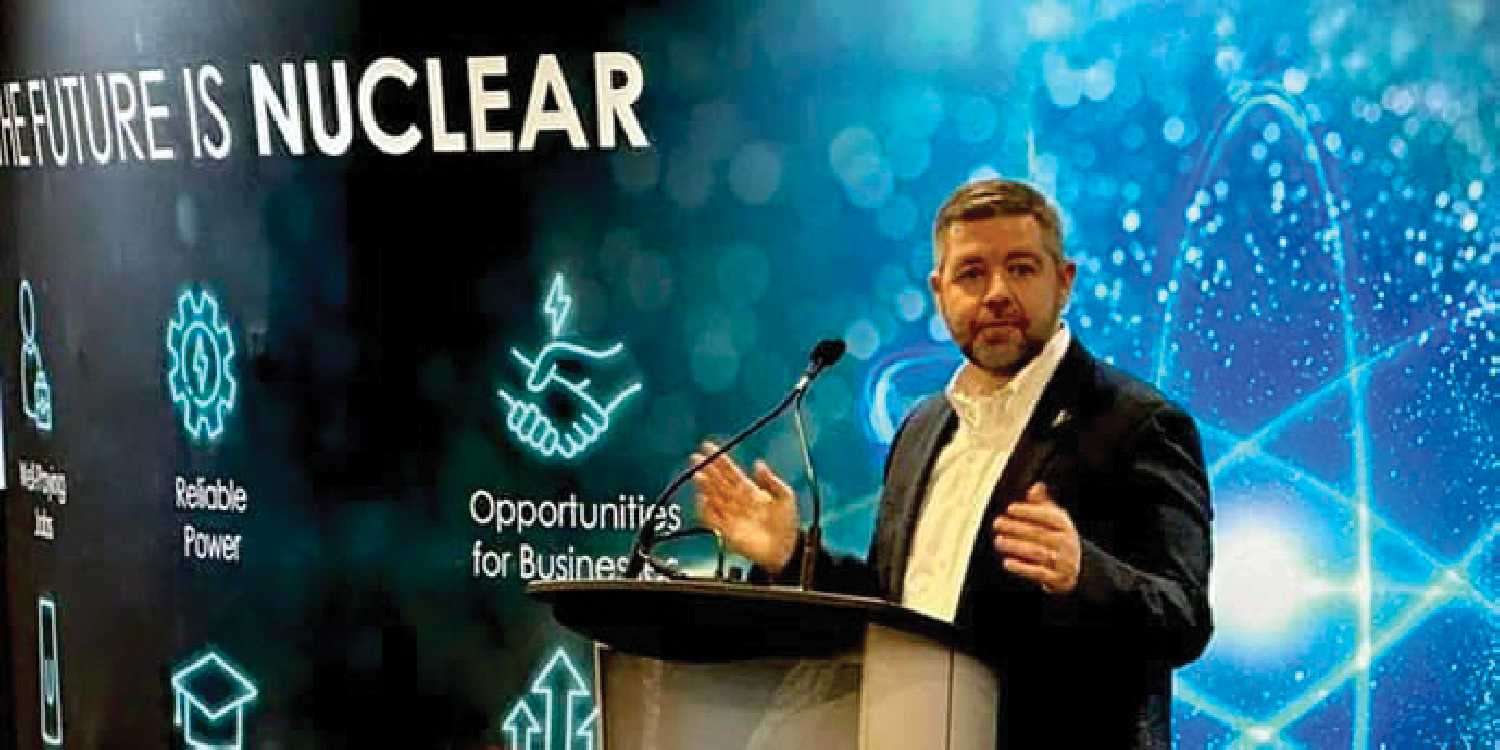

The Government of Saskatchewan and SaskPower have announced plans to formally evaluate large nuclear reactor technologies for use in Saskatchewan. The technology selection process will take place alongside SaskPower’s existing nuclear small modular reactor (SMR) project.
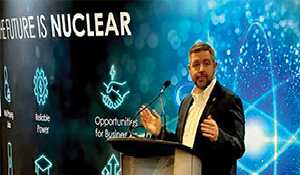
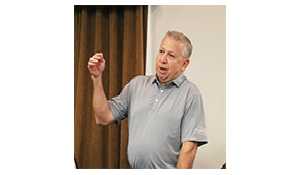
The World-Spectator spoke with Travis Keisig, Legislative Secretary for SaskPower, recently, about that announcement. Following is the interview:
What does a technology selection process entail for evaluating large nuclear reactors?
There’s a myriad of technology globally, because you’re going to be looking at a global context for these technologies. There’s the tested and proven can-do reactors in Ontario. There’s the AP 1000s in Westinghouse, the United Kingdom has several reactor designs. So we’re going to take a broad look at all of those and go through the criteria of fuel availability, technology, deployment, and a lot of steps and processes.
That’s the start of it is kind of looking at the big picture. And then we start whittling it down to what technology would best fit Saskatchewan’s electrical generation needs.
Is this SaskPower and the government saying that they are indeed actually going to go ahead with large nuclear power generation in Saskatchewan?
You have to start the process of looking at what reactor design would work best in Saskatchewan’s environment, what provider can actually provide you with the technology and the unit to build it. So you have to look at a lot of things and we also have to really pay attention to potential costs and what those would be.
Why are these steps being taken now?
We are kind of at a interesting point in time. I mean, the Prime Minister of Canada said repeatedly that he wants Canada to be an energy superpower, and electrical generation is a huge cornerstone of being an energy superpower. And Saskatchewan has a long history of uranium mining, doing it in an environmentally sustainable way, having some of the highest First Nations employment in Saskatchewan.
It’s a great industry. It does so much to help northern residents and all Saskatchewan residents. And so, is this the time that we should be looking at adding nuclear electrical generation to our electrical fleet.
Why do you think Saskatchewan is well positioned to support nuclear power generation?
The fuel source is readily available in Saskatchewan, and if you look at a map, we are in the center of the North American continent, so we can provide electrons down a power line heading south, north, east or west and help sell electricity to all of our neighboring jurisdictions.
If the industry was developed like, what kind of timeline are we looking at?
There hasn’t been a new nuclear jurisdiction in North America in over 40 years. We are breaking ground in Saskatchewan, any place that has built new nuclear reactors had a facility already. Any place that had a facility has been able to add on to their facilities or add another reactor. Like at Darlington (Ontario), the Bruce Power Station has always been there, and they’re adding on a small modular reactor. In Georgia they built two new nuclear reactors there, but there were two reactors already there. They added two more.
To have a brand new, unique jurisdiction, there hasn’t been one started in North America in over 40 years. So, there is a lot of environmental planning that has to go into it. There are a lot of processes that you have to follow, so it’s important that we start the process now, because it takes a long time to get nuclear approval.
When you say a long time, approximately how long?
Between 10 and 20 years.
Where in Saskatchewan would be the best place to develop something like this?
We haven’t really started the site selection process yet. We have to pick a technology and then tailor the site location to the technology’s needs. You first you got to pick which one you want to build, then you have to find a place to build it, and, you have to make sure that you’re doing excellent public engagement throughout the entire process, and keep everyone informed on what’s happening.
How much energy could be created from large nuclear reactors?
Alarge reactor typically generates 1,000 megawatts. So that’s a very substantial portion of our electricity. Typically in Saskatchewan we use between 4,000 and 4,500 megawatts a day. So a large a large reactor would be 1,000 megawatts, so it would be a substantial addition to our electrical generation fleet.
How many jobs do you think could be created if something like this were developed in Saskatchewan?
There would be thousands during construction, and then there would be very good jobs in the operation of the plant. It’s typically a very high end career in the nuclear industry.
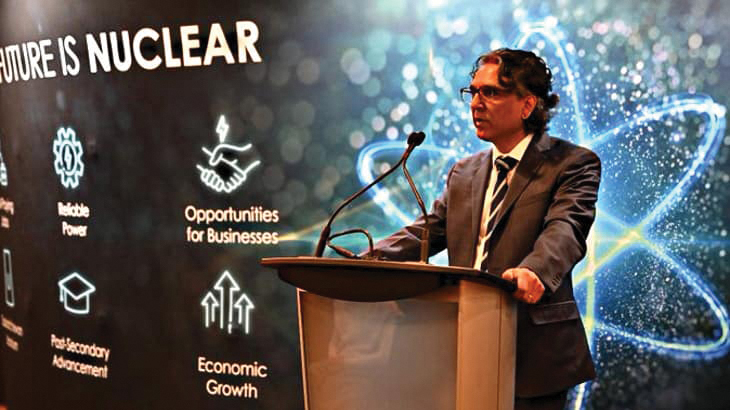
If you’ve chose a site, what kind of infrastructure needs to be developed in order to support large scale nuclear?
There’s a lot of different processes involved and the Canadian Nuclear Safety Commission, CNSC, is very astute in setting out the guidelines and everything else. So that process will happen after technology selection is made, because every technology is a little bit different. So there’s a lot of processes to follow, because safety is always top of mind with nuclear energy.
Does the SaskPower grid currently have the capacity to handle this kind of power?
Yes, absolutely it does.
Whether you’re creating your electrons from natural gas or from solar or wind or coal fired power stations, it’s still an electron. Is an electron running down the line. It’s a little bit challenging for SaskPower, because most of our units are in that typical 300 megawatt range.
Our current plants always have to have what are called turnarounds or shutdowns. You turn the facility off to do maintenance and repairs on it. And a nuclear generating station is exactly the same. So typically it’s a window of every 24 months, it has to be turned off and serviced and refueled. And so you have to have your shutdowns planned accordingly to your power output and everything else, and that is going to be one of the engineering things to work through, is when, if you take a 300 megawatt facility off line in a 4,300 megawatt daily use, it’s very workable in our system. But taking 1,000 megawatts off, you’d have to pay attention to it.
But you wouldn’t have to build extra infrastructure?
No we wouldn’t. But we are adding inter-ties to the southwest power pool—those are currently under construction. And we are also looking at inter-ties to sell more electricity to Alberta, so we have inter-ties with Manitoba, Alberta and the southwest power pool. So we’ll have an opportunity to market any extra electricity that we would produce as a province.
So if large-scale nuclear came online in Saskatchewan, what would the effect be on our Saskatchewan power customers, and also on Saskatchewan’s economy?
We’re kind of laser focused as a government on reliability and affordability—those are our two North Stars.
It’s beautiful weather out today, but January 27 at 7 pm at night is typically, historically, the largest draw in Saskatchewan—it can be minus 40, it’s dark, it’s cold. And so you kind of build your entire electrical grid around that standard. You have to make sure that you’re providing reliable base load electricity to all of the Saskatchewan residents. And that is one thing, that nuclear power is—100 per cent reliable base load electricity.
Would it have any effect on people’s power costs?
Costs are kind of undetermined. As you are able to mass produce and build more of something, typically the prices come down. And when we’re doing selection of technologies, cost is going to be something we’re definitely looking at very hard.
Is there anything else that you think people should know about this?
Alot of people are super excited about the future of the nuclear industry in Saskatchewan, and it’s important for people to understand that there hasn’t been a new jurisdiction in North America in 40 years, so there’s a lot of processes to go through and we’re going to follow all of the steps and do our public engagement or Indigenous engagement as we move through the process.
But we’re excited as a government to see this brought forward. And it’s something that should have been done a long time ago. In Saskatchewan, we’ve been a proud producer of uranium out of this province for generations, and it’s a viable energy source, and it’s critical in today’s day and age,
Because we produce our own uranium, is there a cost savings in that?
The uranium is mined in Saskatchewan, and then it’s refined in Ontario. But you would have reliability of your source of energy. Tweet











-SM.jpg)